
deltalake 1.7.0 for Python is out. The release is mostly about making the
work you already run go faster, with two changes worth calling out.
Merges that read less
Streamed merges now prune target files at runtime using statistics collected
from the source data, so files that cannot match are never opened. On the
TPC-DS inventory benchmark at scale factor 10, a per-file roaring bitmap for
duplicate matches cut peak memory by up to 34% and run time by 7.6%. Merges
into tables with many files also got cheaper to start: merge index buffers are
now allocated on demand, which is 1.9x faster and uses 58% less peak memory when
the input spans 10,000 target files.
A conditional when_not_matched_by_source clause no longer forces a full table
scan, which matters for the common pattern of syncing a table to a snapshot
that removes rows.
What we measured
We ran sink_delta(mode="merge") from Polars 1.44.2 against deltalake 1.6.6 and
1.7.0, on local disk, with the same target tables and sources. The targets are
TPC-DS store_sales and catalog_sales at scale factor 1, split into 10 or 100
files, with and without monthly partitions. Each source is 1% or 10% of the
target rows, with 80% updates and 20% inserts. Every cell ran three times per
build and merge mode, and the chart shows medians.
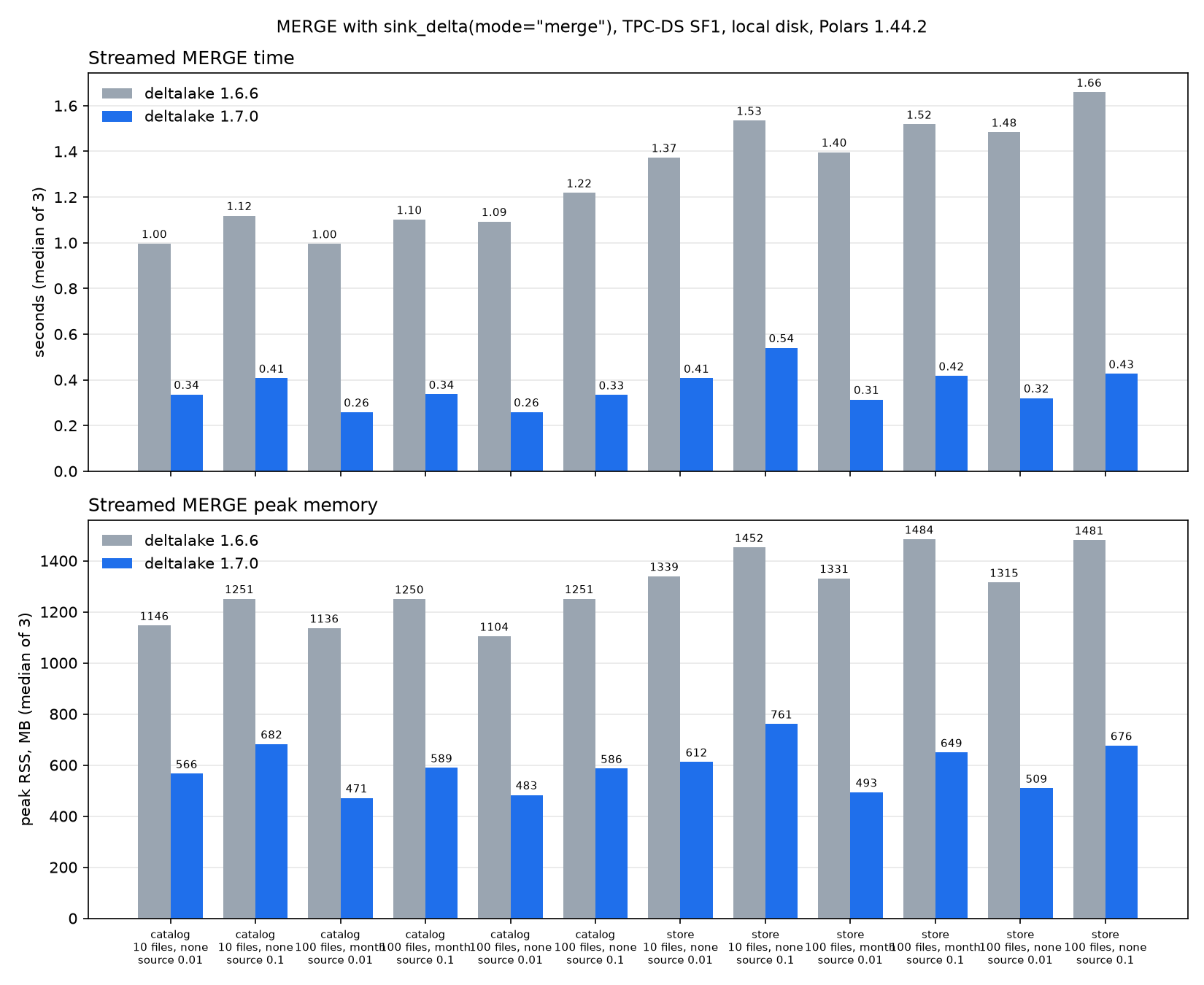
On 1.6.6, the streamed merge took 1.7x to 3.5x as long as the in-memory merge on the same table, and used up to 2.7x more peak memory than 1.7.0. On 1.7.0, the two modes are within about 7% of each other in every cell. Across the 12 cells, the streamed merge is 3.6x faster on 1.7.0 than on 1.6.6 by geometric mean, and uses 1.8x to 2.7x less peak memory.
This is a small run: scale factor 1, one machine, local disk, and no object
store latency. The full grid at scale factor 10 will give stronger numbers. The
harness is in the delta-rs repository under python/bench/streamed_merge.
Catalog-managed commits
Tables managed by a catalog can now have their commits coordinated through that
catalog, and 1.7.0 supports both reading and writing them. The Unity Catalog
integration also moved onto unitycatalog-rs. If you run Unity Catalog tables
from Python, this is the release to test against.
Upgrading
Read the breaking changes before bumping the version. Two are likely to hit existing code:
DeltaTable.history()returns an iterator rather than a list, sodt.history(1)[0]becomesnext(dt.history(1)).updateandmergenow raise an error when an assignment names an unknown column. Previously that assignment was dropped without a message.
The full list, including the default changes to WriterProperties and the UTC
handling of naive datetimes and TIMESTAMP partition values, is in the
python-v1.7.0 release notes.
Faster merges and writes are the kind of change that shows up on the cloud bill before anyone notices the code change. If you want help measuring what 1.7.0 does to your pipelines, drop me an email and let's chat!
